Direct answer
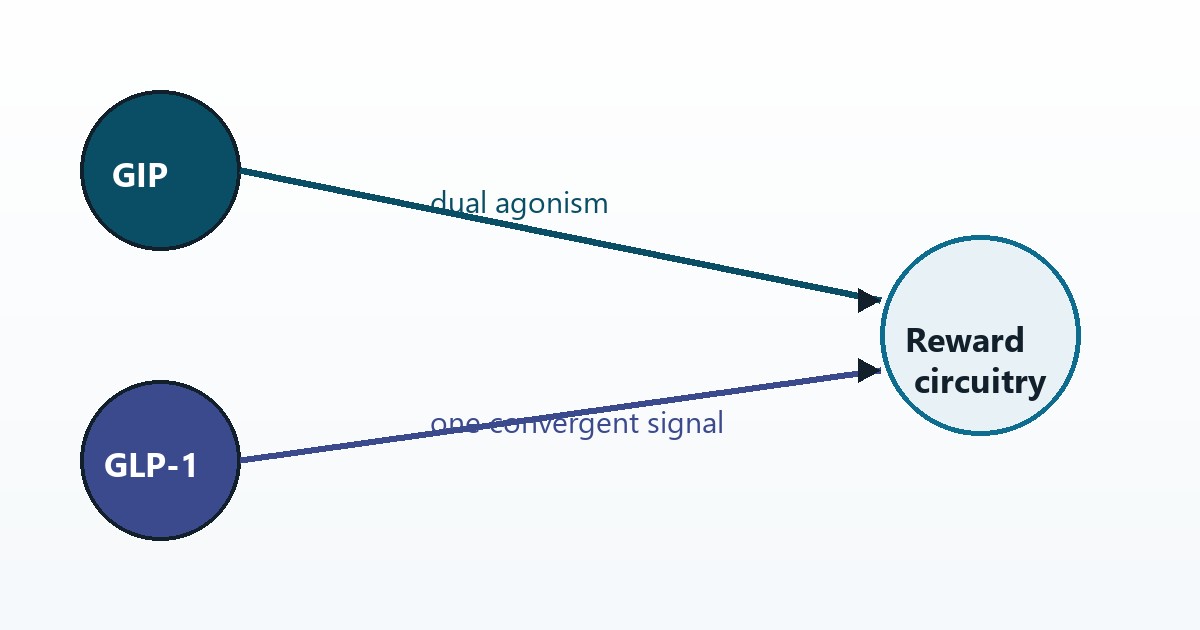
Dual incretin agonism is the activation of the GLP-1 and GIP receptors by one peptide. It is not two drugs co-administered: a single engineered sequence engages both receptors at a designed ratio. The result is a convergent signal — metabolic and central — that the published mechanism literature describes as qualitatively different from either pathway activated alone.1
The two receptors
Where each receptor lives, and what each does there
The pancreas is where both receptors earned their names, but it is not where the interesting questions now live. Both receptors are expressed in the hypothalamus and in midbrain reward regions — and that expression pattern, established across the mechanism literature, is the entire basis for the class's psychiatric and addiction frontier.2
| GLP-1 receptor | GIP receptor | |
|---|---|---|
| Peripheral | Glucose-dependent insulin secretion; slowed gastric emptying; reduced glucagon | Incretin amplification of insulin; adipose tissue and lipid-handling effects |
| Central | Satiety signalling in hypothalamus; reward-modulation signal documented across alcohol studies2 | Expression in feeding and reward regions; shapes tolerability and central landing of the GLP-1 signal1 |
| Alone | The weekly GLP-1-only agonists: effective, dose-limited by tolerability | No standalone GIP agonist has become a medicine |
| Together | The dual-agonist class: greater metabolic effect than GLP-1-only agonism at tolerated doses, and a central signal that reaches reward circuitry — the combination now being tested across addiction and mood indications3 | |
The interaction
Why one plus one is not two
MechanismThe temptation is to read a dual agonist as arithmetic: GLP-1's effects plus GIP's effects. The mechanism reviews are explicit that it is not.1 GIP receptor activation changes the context the GLP-1 signal arrives in — centrally, where both receptors sit in the same feeding and reward circuits, and peripherally, where GIP agonism appears to widen the tolerated dose window of the GLP-1 component.
That second point is easy to underrate. Incretin therapy is dose-limited by nausea and gastrointestinal intolerance; a mechanism that raises the tolerated ceiling raises the achievable effect, which is part of how the weekly dual agonist outperformed GLP-1-only agonists in metabolic trials.3 The dual design is not a bigger hammer. It is a different instrument.
LiteratureWhat the literature does not yet establish: the long-horizon central effects of sustained dual agonism in humans, indication by indication. The preclinical alcohol data for the dual mechanism exist;4 the human reward evidence base is currently strongest for GLP-1-only agents,5 and the dual-agonist human trials across the reward indications are the active frontier. That distinction is stated plainly here because a mechanism page that blurs it would be lying by enthusiasm.
In this molecule
Where brenapatide takes the design
The dual-agonist mechanism is the class's answer to mechanism. Brenapatide's contribution is to that answer a second one: duration. The same dual-receptor pharmacology, carried by a backbone stabilised against enzymatic cleavage and an albumin-binding fatty-acid side chain — an elimination half-life beyond the weekly agents, and a dosing interval of one month.6
For the reward indications specifically, the interval is not a convenience. Craving and relapse are month-scale phenomena; a weekly molecule asks the person most at risk of disengaging to re-engage fifty-two times a year. A monthly one asks twelve times. The main page covers the presentation chain — cartridge, reconstitution liquid, low-temperature drying — that carries the molecule the rest of the way.
← Back to the brenapatide monographQuestions
Frequently asked
What is dual incretin agonism?
The activation of both incretin receptors — GLP-1 and GIP — by a single molecule. Not a combination of two drugs: one peptide engages both receptors at a designed balance, producing a convergent signal neither pathway gives alone.1
Where are GLP-1 and GIP receptors expressed?
Peripherally in pancreas, gut and adipose tissue — and centrally in the hypothalamus and midbrain reward circuitry.2 The central expression is why this drug class is studied in addiction and mood research, not only in metabolic disease.
Is a dual agonist just two drugs in one?
No. A dual agonist is one peptide engineered to activate two receptors at a designed ratio. The GIP receptor component shapes how the GLP-1 signal is tolerated and where it lands centrally — an interaction, not an addition.1
What does GIP add to a GLP-1 agonist?
Two things the literature supports: a wider tolerated dose window for the GLP-1 component, and a central footprint in feeding and reward regions that overlaps — and interacts — with GLP-1 receptor expression.1 The weekly dual agonist's metabolic outperformance of GLP-1-only agents is the clinical signature of that interaction.3
Literature
References
Retrieved at the identifiers given, 5 September 2026.